Outer Banks septic guide
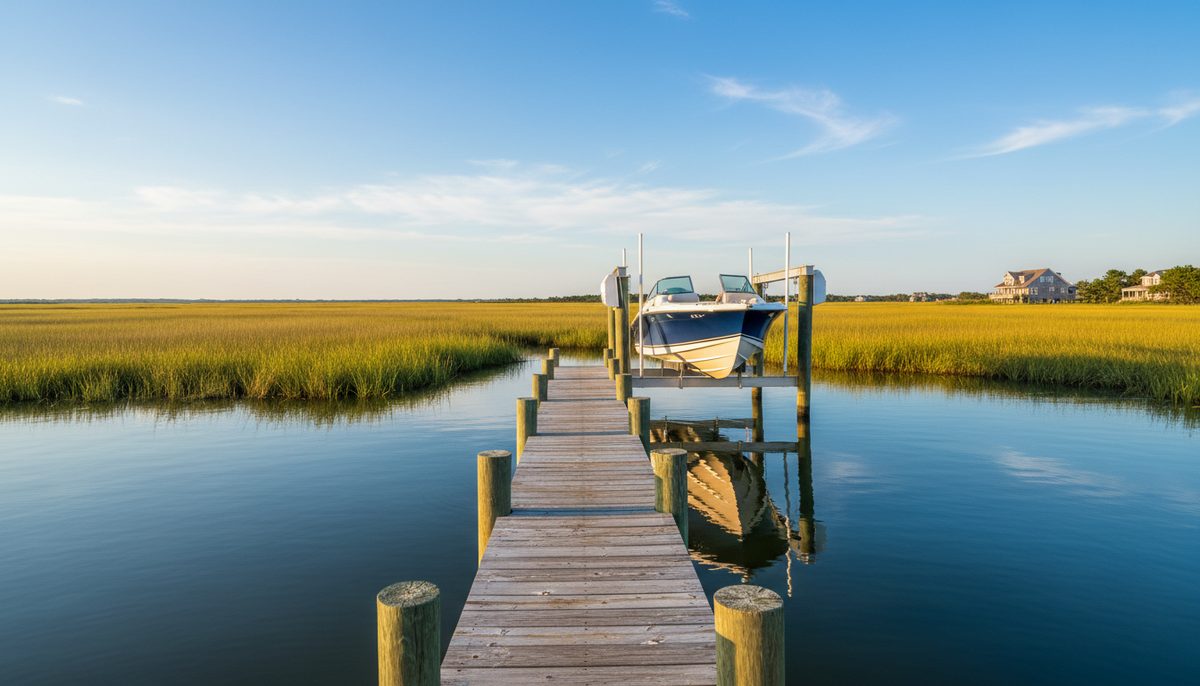
How far can a dock extend into the sound in North Carolina?
Two independent CAMA caps rule dock length in North Carolina: the 400-foot waterward limit and the one-fourth width rule — and your boat lift sits at the end of that arithmetic.
Two caps rule the answer, and they are independent: a fixed distance and a proportion. A pier or docking facility under the CAMA general permit may reach Pier/dock may extend max 400 ft waterward from the normal high water line, while the broader use standard adds Pier length limited to one-fourth of water body width — one-fourth of the width of the water body, measured from the waterward edge of bordering coastal wetland vegetation. Whichever of the two is shorter on your lot is your limit, unless an official pier-head line has already been established for the water you front.
The details
Take the distance cap first, because it is the one most owners already half-know. Under 15A NCAC 07H .1205(a), the general permit lets a pier run at most 400 feet waterward from the normal high water line or normal water level. The escape hatch is real but narrow: a longer structure must carry a deeper-water justification, and the rule prices that justification at a rate of at least one foot of additional depth for every further hundred-foot increment you want. In other words, the state will let you run longer only where the water in front of you genuinely gets deeper as you go — which is a measurement, not an argument.
The proportion cap is the one that surprises people on canals and basins. The use standard at .0208(b)(6)(G) limits a pier to no more than one-fourth the width of the natural water body, canal, or basin it fronts — so a hundred-foot canal effectively ends every pier on it at twenty-five feet regardless of what the distance rule would allow. Note where the tape measure starts: from the waterward edge of the bordering coastal wetland vegetation, not from your surveyed property line, not from the bulkhead, and not from the grass you mow.
The exception to remember: an official pier-head line established by the U.S. Army Corps of Engineers or a local government overrides the one-fourth rule. If your water body has one, that line — not the arithmetic — marks where building stops. Most private sound-front lots do not have one; the harbor basins and maintained channels increasingly do. It is the first question to answer before anyone draws anything.
Now the part this site cares about, because the dock is only the runway. The reason sound-side piers run long in the first place is Shallow sounds behind the OBX — the Pamlico, Albemarle and Currituck waters behind the islands are shallow for miles, so the usable depth sits far waterward of the shoreline. Your boat lift lives at the far end of that reach, which means every foot of permitted length is a foot of cable run, a foot of wiring, and a foot of walk for the crew that eventually services the machinery. A pier engineered to its legal maximum carries real maintenance consequences along with its boats.
A practical sequence for an owner planning a new pier or an extension. Establish the normal high water line or normal water level first, because the 400 feet is measured from it — measuring from the sand at low tide flatters your pier by the tide range. Then find the waterward edge of any coastal wetland vegetation for the width measurement, and the width of the water body itself. Then check for a pier-head line. The shortest of the resulting answers is the one your CAMA application will be held to, and knowing it before the contractor mobilizes is the difference between a permitted project and a very expensive stub.
Four hundred feet, or one-fourth of the width of your water, or the pier-head line — measure all three before you build, and remember your lift rides at the end of whichever one wins.
On the record: Pier/dock may extend max 400 ft waterward (NC DEQ Division of Coastal Management — 15A NCAC 07H .1200 General Permit for Piers and Docking Facilities (retrieved 2026-09-17)) · Pier length limited to one-fourth of water body width (NC Office of Administrative Hearings — 15A NCAC 07H .0208(b)(6)(G) (retrieved 2026-09-17)) · Shallow sounds behind the OBX (NCpedia — Outer Banks (retrieved 2026-09-17))
Hand-verified 2026-09-17 against the primary sources named above; where a fact could not be verified it was left out, never guessed.