Outer Banks septic guide
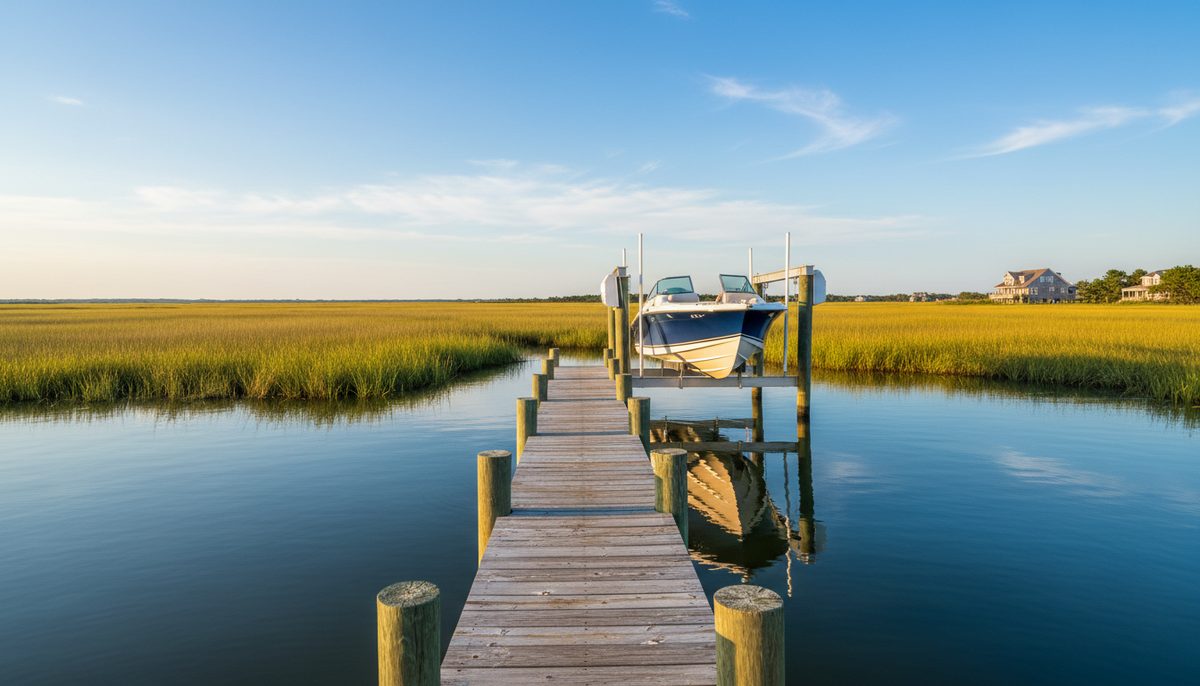
Can you build a covered boat lift in North Carolina?
Yes, with limits: NC CAMA rules allow a roof over a docking facility but require it to stay single story — plus the 400-sq-ft caps on the lift and its components.
Yes — and the yes comes with one architectural sentence attached. Docking facilities single story: CAMA rules at 15A NCAC 07H .0208(b)(6)(F) and .1205(n) require piers and docking facilities to be single story; they may be roofed, but they shall not be designed to allow second-story use. So the roof over your lift is lawful, ordinary, and common on this coast — what is not lawful is designing the structure so that anyone could stand, store, or build on top of it.
The details
Read that rule the way a permit reviewer reads it, which is by design intent rather than by structure. 'Shall not be designed to allow second-story use' is not a height number — it is a prohibition on the features that make a second story usable: joists and decking meant to carry a person, stairs or a ladder built into the structure, railings up top, anything that invites or permits occupancy above the roof line. A roofed lift whose framing carries only wind load passes. The same square footage with a stair tacked on fails, and it fails at the least convenient possible moment in the permit process.
The roof brings the size rules with it, because a covered lift is a docking facility with components and everything over the water gets measured. The lift itself is capped at Boat lift max area 400 sq ft of enclosed area under the use standard, with a documented-need exception for boats that genuinely require a larger lift. Under the general permit, any individual component of the docking facility is capped at Max 400 sq ft per dock component. A roof is a component, a platform is a component, and the arithmetic that mattered for the bare lift does not go away because someone added a roof over it — it just gains a line item.
There is a third ceiling above the first two, and it exists because roofs shade water. The use standard caps total shaded square footage of docks, platforms, and mooring facilities — the pier itself excluded — at eight square feet per linear foot of shoreline with a maximum of Subchapter 7H use standard shade cap: max 2,000 sq ft, and projects exceeding it must justify greater dimensions. The rule is written around what shading does to the substrate beneath, which is also why uncovered open-water slips are treated more gently than covered ones: your roof is, to the reviewer's eye, a shaded impact, and it gets counted like one.
A distinction worth drawing while we are here: a roofed lift is not a boathouse. A boathouse is its own category with its own rule — capped at 400 square feet of greatest exterior dimension and not allowed at all on lots with less than 75 linear feet of shoreline — and the difference is not cosmetic on a permit application. If what you actually want is walls, a hoist beam, and a garage door over the water, that is a boathouse conversation, not a covered-lift conversation, and it is worth having with the right word attached before the plans get drawn.
The engineering reality of a covered structure on this coast deserves the last paragraph, because the permit is not the hard part. A roof at the end of a sound-side pier — and sound-side piers run long precisely because of Shallow sounds behind the OBX — is a sail mounted on the machine that holds your boat over open water. It catches every north wind that crosses the Albemarle and every tropical system that bends up the coast, and it transfers what it catches into the same pilings and framing that carry the lift. Covered lifts fail in weather, not in review; build the roof for the storm, and the rule about second stories tends to take care of itself.
Roof over the lift: yes. Second story over the lift: no, by design and by rule. Bring us the boat and the shoreline, and we will size a covered lift that clears every cap on the list.
On the record: Docking facilities single story (NC Office of Administrative Hearings — 15A NCAC Subchapter 7H (retrieved 2026-09-17)) · Shallow sounds behind the OBX (NCpedia — Outer Banks (retrieved 2026-09-17)) · Boat lift max area 400 sq ft (NC Office of Administrative Hearings — 15A NCAC Subchapter 7H, State Guidelines for Areas of Environmental Concern (retrieved 2026-09-17))
Hand-verified 2026-09-17 against the primary sources named above; where a fact could not be verified it was left out, never guessed.