Outer Banks septic guide
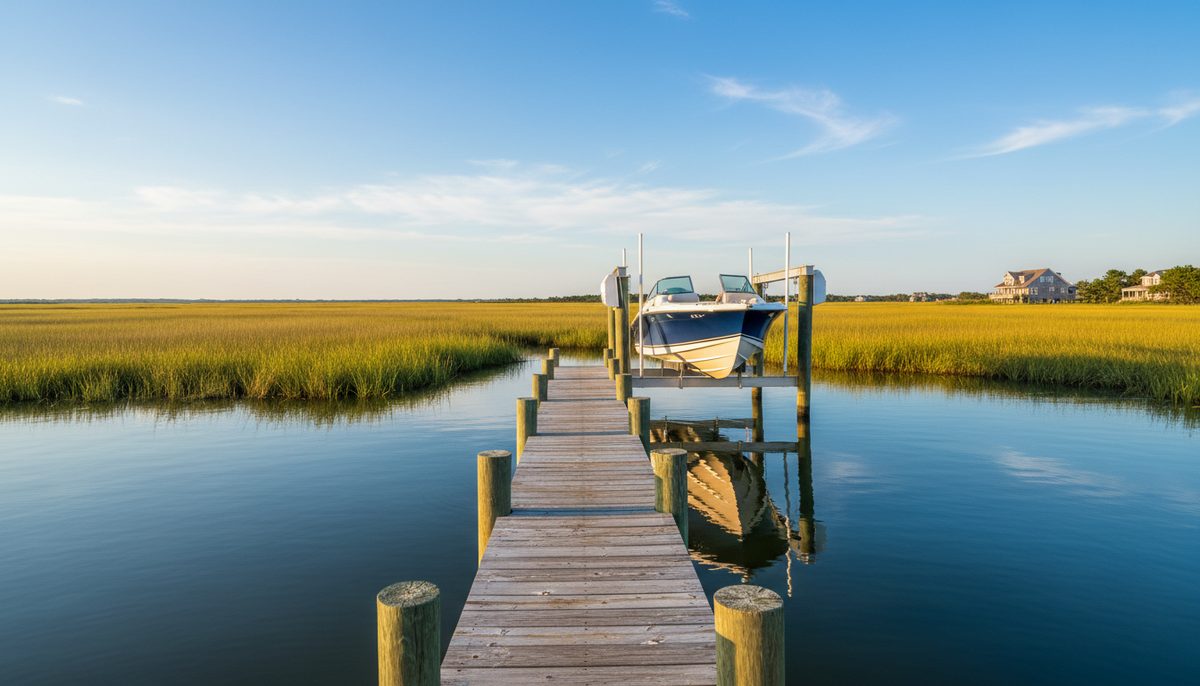
The best boat lift for a shallow soundside lot
How to choose a boat lift for a shallow soundside lot: read your depth at low water, your bottom, and the 18-inch floating clearance rule before you choose a mechanism.
On a shallow lot, the lift does not choose you — the water does. The decision runs off three measurements and one map line: your depth at normal low water, the bottom your pilings or floats would sit on, whether a fixed or floating mechanism fits that depth, and whether the water in front of you carries a Primary Nursery Area, shellfish bed, or submerged aquatic vegetation designation. Everything else — brand, gadget, remote — is a detail. This coast's lots front Shallow sounds behind the OBX, and that fact makes those four checks the entire decision.
The details
Depth first, and at low water, because the wrong tide turns good measurements into lies. What a lift needs is not the depth you see at mid-afternoon but the depth at normal low water — the number that determines whether a cradle can hang, whether a hull can swing clear, and whether a floating lift ever floats level. A lot with three feet at low water and a soft bottom is a different engineering problem from a lot with eighteen inches over firm sand, and both are different again from the rare sound-side lot that holds real depth close to the shoreline.
Then the map line, because on this coast it can decide the mechanism before any preference does. Floating piers and floating docking facilities — which include the floating lifts marketed to shallow lots — are allowed over Primary Nursery Areas, shellfish beds, or submerged aquatic vegetation only under a hard condition: Floating lifts/docks: 18-in clearance at low water of water between the bottom of the structure and the substrate at normal low water level. If your waterfront carries one of those designations and the low-water depth is short of that mark, the floating option is not merely inferior — it is not permitted. A fixed lift on pilings is a different structure under the rules and faces a different analysis. This is a check you make with the Division before the deposit, not after the delivery.
On capacity, a deliberate silence. We do not publish pound-class recommendations, because lift capacity ratings are manufacturer data rather than an authoritative market fact, and the cost of a guessed rating is a stalled cradle or worse. What we will say is the honest method: weigh the boat as it actually goes in the water — hull, motor, full fuel, gear, ice — and then buy margin above that number, because the rating that exactly matches your boat is the one that is exactly at its limit every single day. A dock-side conversation about your actual boat beats any chart on any website, ours included.
The same honesty applies to the water itself: we do not print average depth figures for the Pamlico or the Albemarle, because those figures were never verified against a primary source. What is verified is qualitative and sufficient for planning — the sounds are shallow, and sound-side lots must often extend well waterward to reach usable depth. Measure your own lot's low-water depth; the sound-wide average never launched anyone's boat.
Whatever mechanism the water selects, the size question has a fixed ceiling above it: Boat lift max area 400 sq ft, the CAMA use-standard cap on the total area a single lift may enclose, with a documented-need exception for boats that genuinely require more. A shallow lot does not buy relief from that cap; it just makes the footprint arithmetic matter earlier, because shallow lots tend to carry narrow permits.
And because this site exists for the second decade of the decision, not the first: choose the lift your future repair crew can service. Motors that can be reached from the dock rather than from a jon boat, cable paths that a technician can inspect, a disconnect that is not buried behind a decade of growth. Every lift eventually needs the truck, and the shallow lots we service cheapest are the ones whose owners thought about that truck while the lift was still on paper.
Low-water depth, bottom, designations, capacity with margin — in that order. Call with your lot's numbers and the boat's real weight, and the mechanism question answers itself.
On the record: Shallow sounds behind the OBX (NCpedia — Outer Banks (retrieved 2026-09-17)) · Floating lifts/docks: 18-in clearance at low water (NC DEQ Division of Coastal Management — 15A NCAC 07H .1200 General Permit for Piers and Docking Facilities (retrieved 2026-09-17)) · Boat lift max area 400 sq ft (NC Office of Administrative Hearings — 15A NCAC Subchapter 7H, State Guidelines for Areas of Environmental Concern (retrieved 2026-09-17))
Hand-verified 2026-09-17 against the primary sources named above; where a fact could not be verified it was left out, never guessed.