Outer Banks septic guide
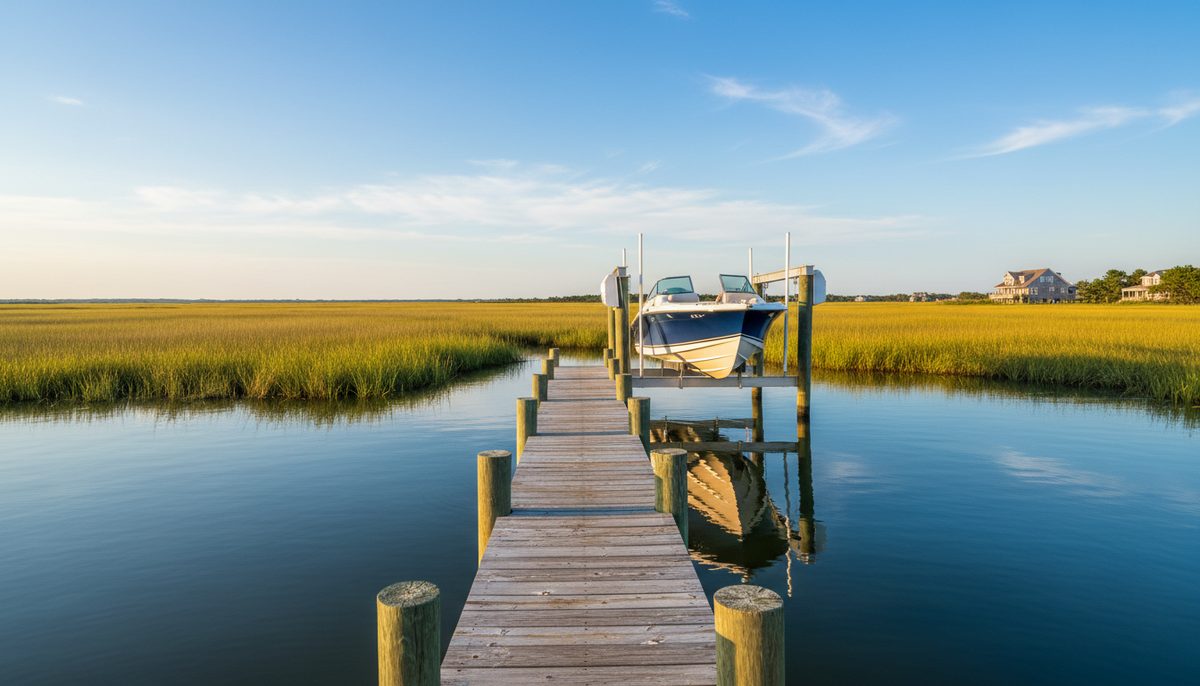
The CAMA permit process for a dock and boat lift
The CAMA general permit sequence for a pier, dock, or boat lift: adjacent-owner notice by certified mail, the on-site meeting, the 120-day completion clock, and the 15-foot riparian setback.
The CAMA process for a pier, dock, or boat lift is less a review than a sequence, and almost every step of it involves your neighbors before it involves the state. The general permit track — which covers the ordinary private pier — runs: adjacent-owner notice, an on-site meeting with the Division of Coastal Management, a written authorization, and a construction clock that starts the day it issues. Skip a step or miss the clock and the authorization you thought you had is gone.
The details
Step one is the notice, and it is procedural rather than persuasive. Before a CAMA general permit for a pier, dock, or boat lift can be issued, you must obtain a no-objection statement from adjacent riparian owners or notify them by certified mail — Adjacent-owner notice by certified mail — and owners have 10 days from receipt to comment in writing, after which silence is treated as no objection. The certified mail piece is not a formality: it is what makes the 10-day clock legally count. A friendly conversation over the fence is neighborly and worth having, but it does not start anyone's clock.
Step two is the on-site meeting, and it is a hard gate rather than a courtesy. Under the general permit approval procedures, no work may begin before a Division of Coastal Management representative has met you on the site — not staked-out-adjacent-to, not photographed-from-the-road, on the site. The meeting is where the alignment, the setbacks, and the waterward reach get reconciled against what the rules actually say about your shoreline, and it is the cheapest hour in the entire project budget.
Step three is the clock. General permit: build within 120 days: construction under a general permit must be completed within 120 days of issuance, or the authorization expires and the project must be re-examined — the permit is a fuse, not a trophy. The practical consequence is scheduling: the contractor who cannot mobilize within the window is the contractor who turns your authorization back into an application. Ask about the 120 days before you sign, not after the pilings get delayed.
Step four is the line the whole design gets drawn around: 15-ft riparian setback, the minimum setback between any part of a pier or docking facility — the rule names boat lifts specifically — and the adjacent property owner's area of riparian access. Fifteen feet from your neighbor's riparian area, measured on the water, not on the plat. The waiver is real: the setback may be waived by written agreement of the adjacent riparian owner, which turns a boundary risk into a signature and is worth having in the file before construction rather than after the first argument.
Two boundaries on this page, stated because guessing them would be worse. The general permit track carries its own content limits — docking space for two boats is the figure it is written around — and projects that exceed what the general permit authorizes are reviewed through the major permitting process, which is a different schedule, a different fee structure, and a different conversation. And whether CAMA treats the replacement of an existing, non-conforming lift as new construction or as a repair-in-place is a Division interpretation the fetched rules do not settle — so before the old lift comes out, ask. The answer is knowable; it is just not on this page, because nobody verified it.
Put together, the process for an ordinary private pier with a lift is: notice your neighbors by certified mail or collect their no-objection statements, meet the Division on the site, build inside the 15-foot setback line (or bring the written waiver), finish inside 120 days, and keep every piece of paper. The owners who do it in that order spend the least time in it. The ones who start with the contractor spend the most.
Planning a pier or a lift? The sequence is notice, site meeting, setback, clock — call and we will walk your shoreline through it before anyone orders pilings.
On the record: Adjacent-owner notice by certified mail (NC DEQ Division of Coastal Management — 15A NCAC 07H .1202 Approval Procedures (retrieved 2026-09-17)) · General permit: build within 120 days (NC DEQ Division of Coastal Management — 15A NCAC 07H .1200 General Permit for Piers and Docking Facilities (retrieved 2026-09-17)) · 15-ft riparian setback (NC Office of Administrative Hearings — 15A NCAC 07H .0208(b)(6)(I) (retrieved 2026-09-17))
Hand-verified 2026-09-17 against the primary sources named above; where a fact could not be verified it was left out, never guessed.